

The Xen Project is back from Open Source Summit Japan and Automotive Linux Summit 2025. This year’s event felt like a true watershed moment for the automotive industry and for open source. Across talks, demos, and hallway conversations, one thing was clear: open source is now a foundational pillar for the future of software defined vehicles.
The conference halls were packed with engineers from many different organizations, all collaborating toward a shared goal: powering the next generation of vehicles in the open. For the Xen Project, this was a particularly special moment. Our membership spans the full spectrum of the industry, from silicon vendors like Arm and AMD, to automotive OEMs, to companies building large-scale server and cloud infrastructure. Our members brought bold ideas, real hardware demos, and a consistent message: open source in automotive is no longer experimental. It is becoming the default implementation.
Everywhere on the show floor, Xen was quietly doing its job behind the scenes. That same hypervisor is also trusted every day in data centers and cloud environments, which is a reminder of how versatile the Xen architecture really is. It appeared again and again as the hidden layer enabling mixed criticality workloads, cockpit virtualization, and full software defined vehicle stacks. The momentum this year was undeniable.
The Xen Project brings together silicon vendors like Arm and AMD, automotive OEMs, and companies building large-scale server and cloud platforms. This cross-industry collaboration is what makes Xen a strong foundation for long-lived automotive systems.
Software Defined Vehicles: an Automotive Revolution
As Dan Cauchy explained clearly in his opening keynote, and as nearly every session reinforced afterward, a fundamental shift is underway in how vehicles are designed. Historically, cars were built hardware first. The hardware defined the vehicle, and software was written specifically to fit that hardware.
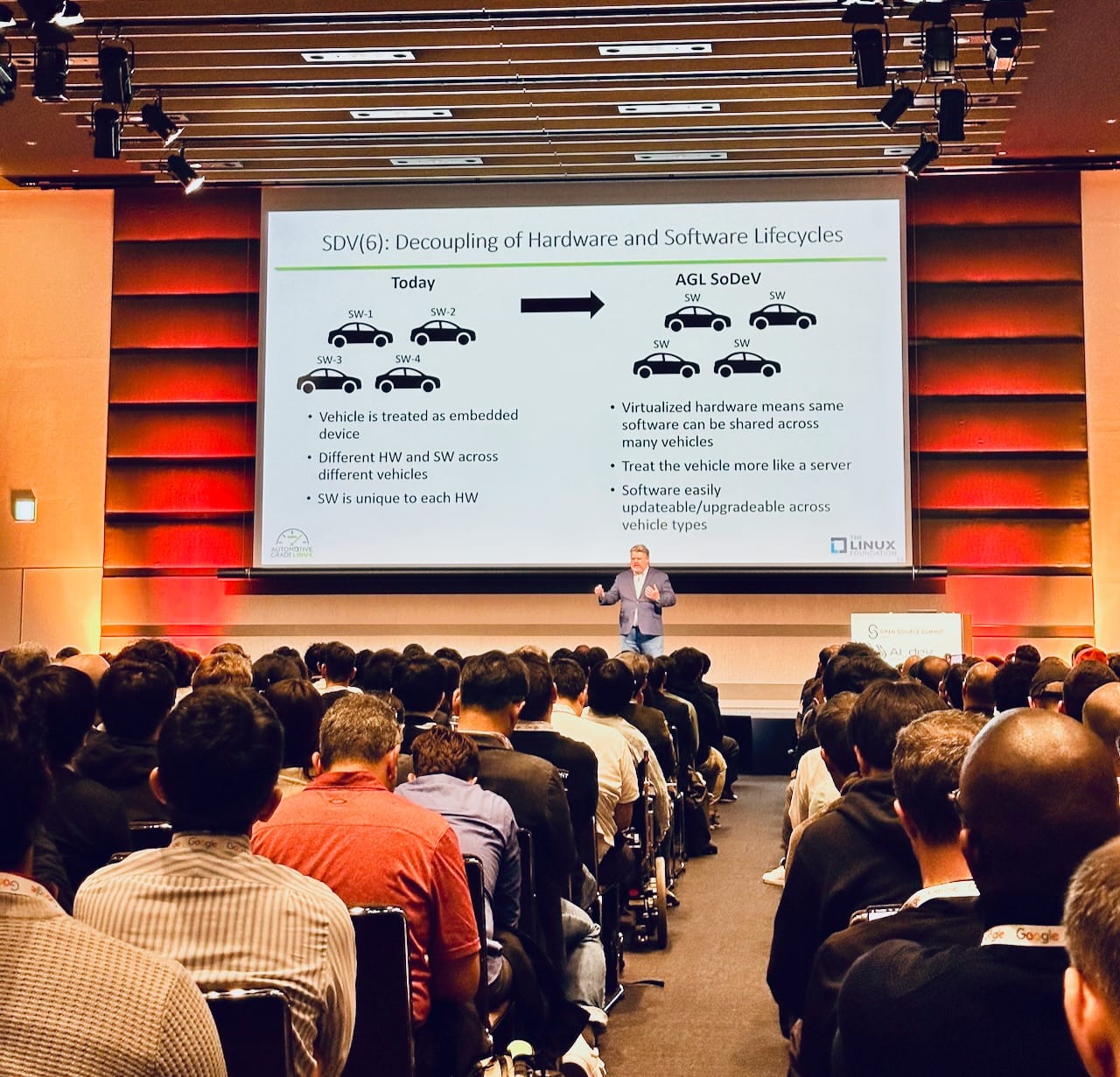
That model is now being inverted. Software is becoming the defining element of the vehicle experience, while hardware is increasingly abstracted beneath it. This is a familiar pattern. We have already lived through the same transformation in the mobile phone industry, where features are now driven by operating system versions rather than by individual hardware models.
The automotive industry is following the same path. Software stacks are no longer tightly bound to a single model or trim level. Updates are no longer rare events tied to maintenance cycles. Instead, manufacturers are moving toward unified software platforms that span multiple vehicles, generations, and hardware configurations.
In the near future, a manufacturer’s software stack will run across a wide range of models and SoCs. The software will define the experience, while hardware diversity is handled through abstraction layers. Throughout the summit, we saw concrete progress toward this vision.
Renesas showcased the powerful SoCs needed to support mixed criticality workloads. Honda brought these pieces together by showing how open source software stacks can be deployed in real vehicles. Along the way, complementary work from companies like Panasonic on VirtIO and cockpit abstraction illustrated how shared standards enable this ecosystem to scale.
Honda and Renesas: Leading the Charge Toward Open SDVs
Two Xen Project board members stood out from the very beginning of the event: Honda and Renesas. Alongside them, other major automotive players, including Ford, are members of the Xen Project, reinforcing that this work is not theoretical but already aligned with real industry adoption. Their talks, booth demos, and architectural choices showed exactly how open source can accelerate automotive innovation.
Honda: building in house software with open source at the core
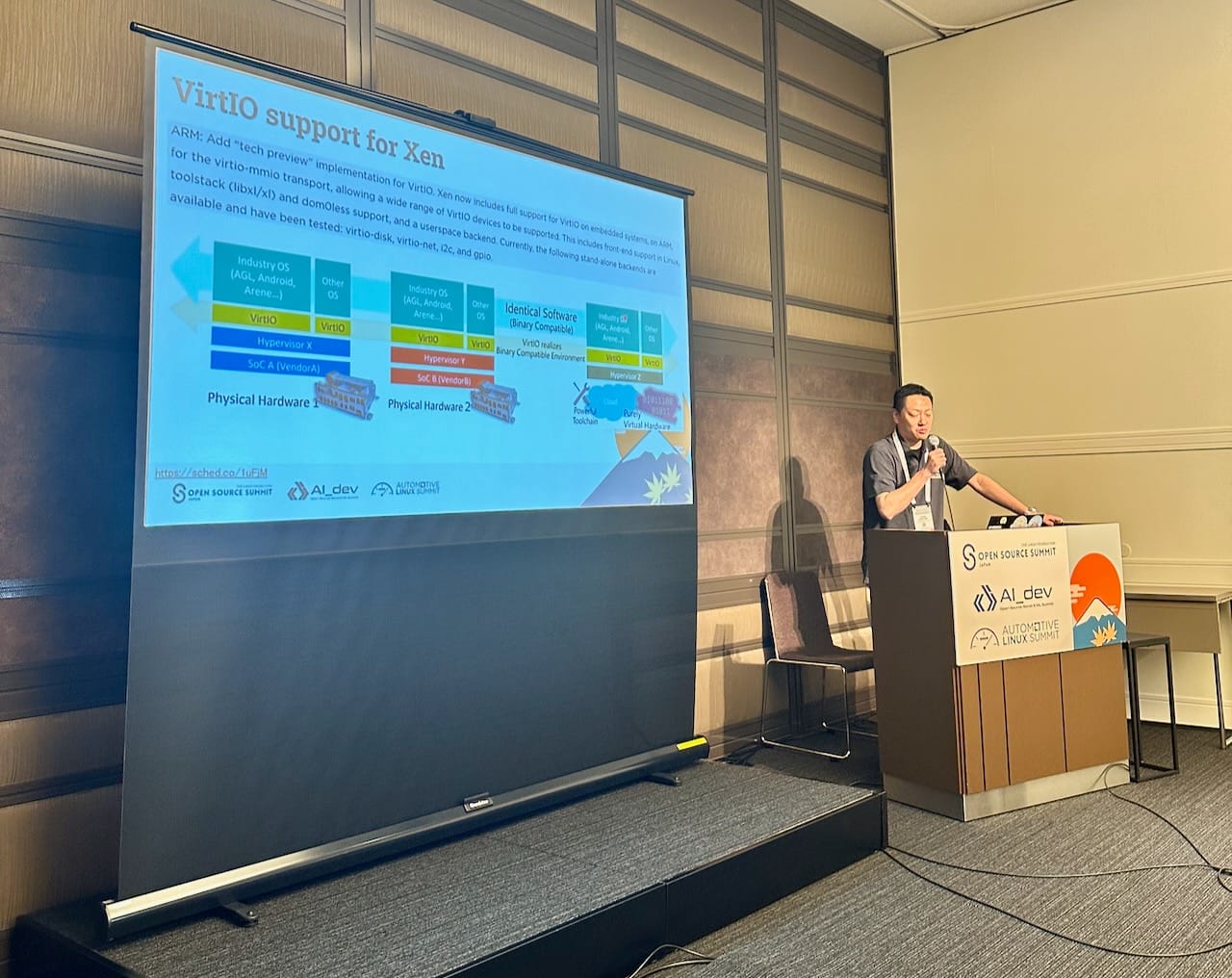
Yuichi Kusakabe gave several compelling talks describing how Honda grew an in house IVI software team from just two people into a modern organization fully committed to open source. The story was both honest and inspiring. Honda adopted AOSP, embraced SPDX and OpenChain for compliance, built strong internal processes, and delivered production quality IVI software on open foundations.
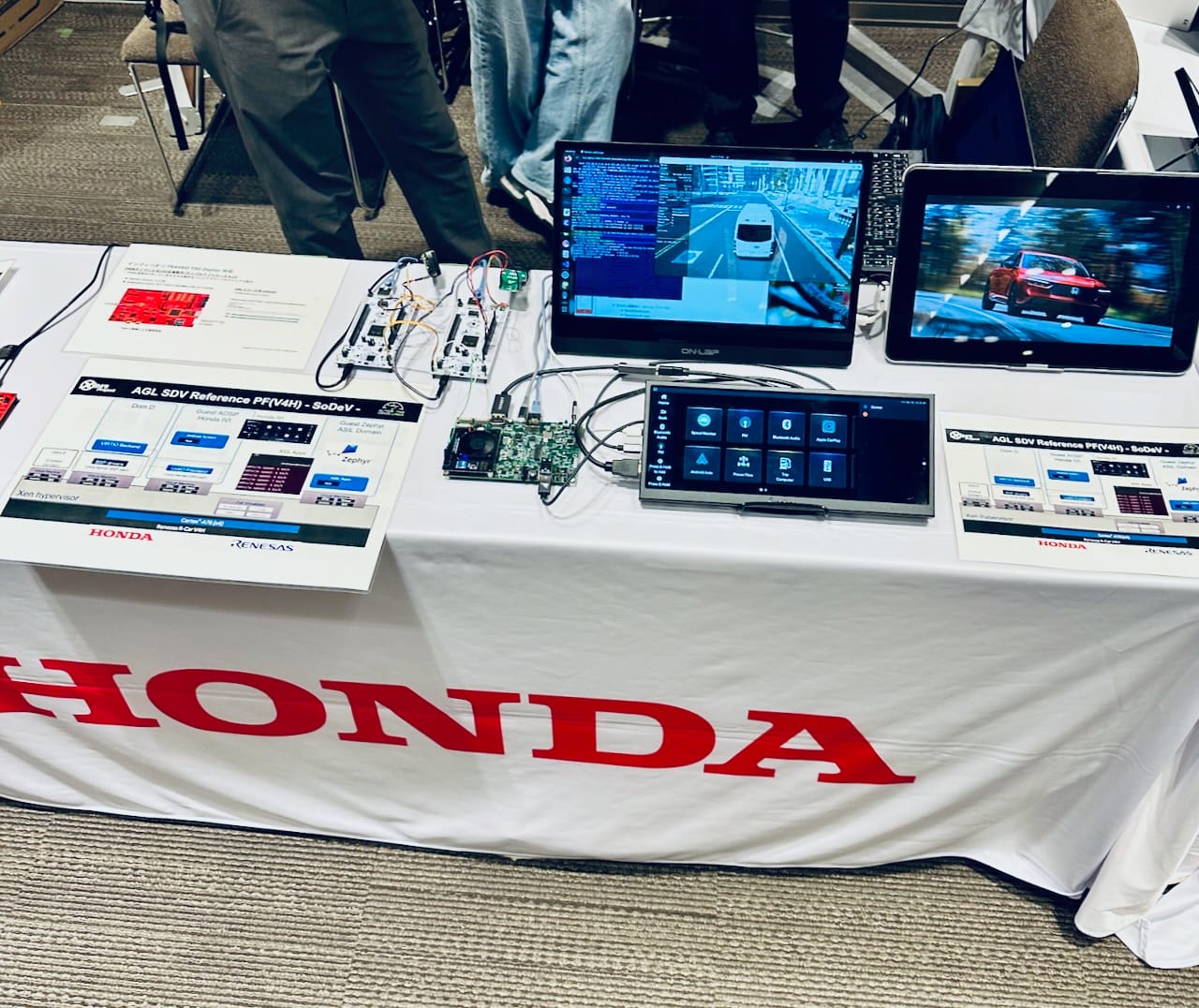
On the show floor, Honda featured multiple demos running on Renesas hardware with Xen as the hypervisor. These systems followed the AGL reference architecture that appeared in nearly every presentation throughout the event. Seeing real cockpit consoles running on Xen was a powerful confirmation of the direction the industry is taking.
Renesas: turning SDV concepts into real hardware
Renesas delivered one of the strongest technical showings at OSSJ. Their sessions highlighted a unified development environment that bridges Linux, Zephyr, Yocto, and Xen on next generation R-Car SoCs. At their booths, engineers could see real hardware running real mixed criticality workloads side by side, all orchestrated by Xen.
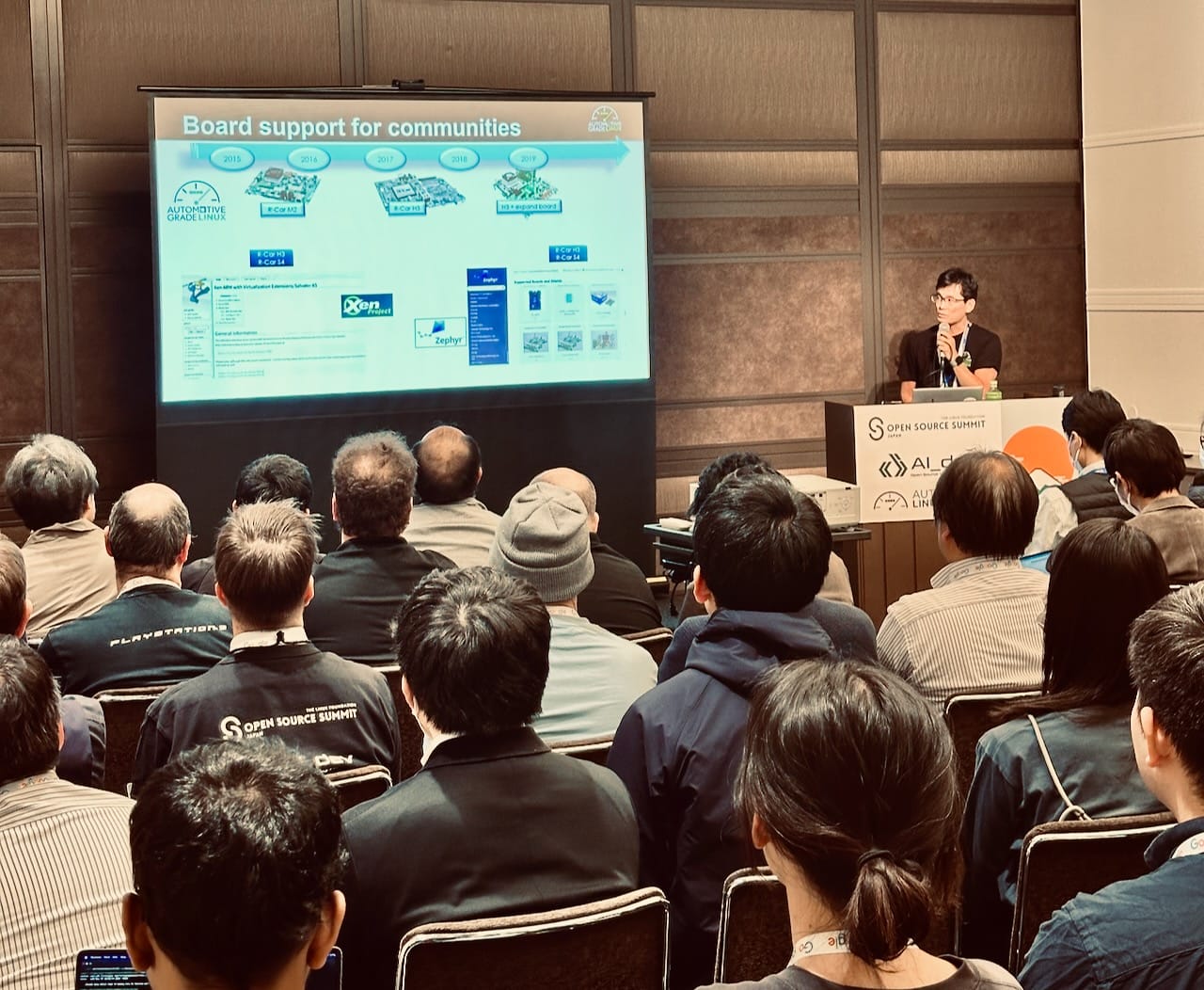
Renesas also presented a heterogeneous compute platform combining Cortex A76 application cores, Cortex R52 real time cores, and an onboard AI accelerator. This reflects where automotive systems are headed. Workloads are increasingly diverse. Real time constraints coexist with high level applications and AI inference. Xen provides the isolation and flexibility needed to bring these elements together on a single SoC.
What stood out most was the confidence Renesas showed in demonstrating Xen on safety oriented hardware. Vendors do not make these demonstrations lightly. Renesas is now publicly working toward safety certification for Xen, aligning with the safety milestones discussed in my talk. One year after AMD achieved safety concept approval, Renesas has clearly joined the same path forward.
Panasonic: advancing VirtIO and cockpit decoupling
Panasonic delivered several strong engineering sessions that complemented the broader SDV story at the conference. Their updates from the SDV Expert Group and their work on VirtIO testing highlighted steady progress toward better virtualization quality and interoperability.
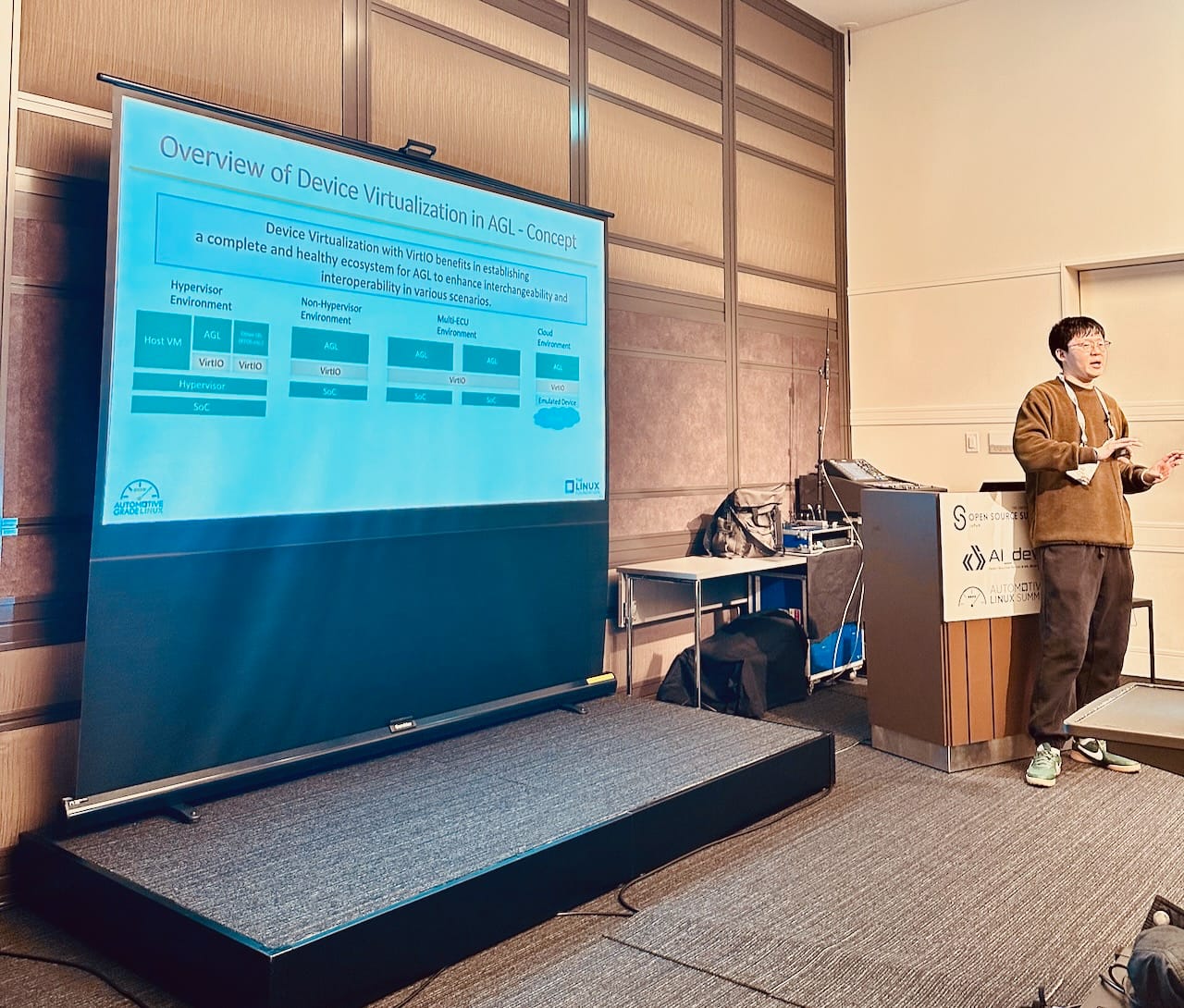
The Unified HMI v2.0 presentation was a good illustration of where cockpit architectures are heading. By decoupling displays from the applications that render them, and by supporting multiple writers and multiple screens across AGL and Android, Panasonic showed how virtualization can simplify complex UI pipelines.
While Panasonic is not currently a Xen Project member, their work clearly contributes to the wider ecosystem that many of our members are building upon. These efforts reinforce the importance of open interfaces and shared standards in modern automotive stacks, and they align naturally with Xen-based SDV architectures.
A Shared Architecture Emerges: AGL SoDeV Takes Center Stage
One of Xen’s unique strengths is that the same core hypervisor technology is used across embedded, automotive, and server environments. Members such as Citrix (XenServer) and Vates build Xen-based solutions for large-scale server and cloud deployments, while automotive members apply Xen to safety critical and embedded systems. This shared foundation allows improvements in security, performance, and tooling to benefit all deployment models.
At the heart of nearly every SDV discussion was the same core stack: AGL on top of Linux, Xen providing isolation and virtualization, and Zephyr acting as the real time operating system for safety and control oriented workloads. This combination appeared consistently across talks, demos, and reference diagrams.
One theme appeared again and again throughout the summit. Nearly every presentation included the same AGL Software Defined Vehicle architecture diagram. At its core were VirtIO, Yocto, Zephyr, and Xen as the hypervisor.
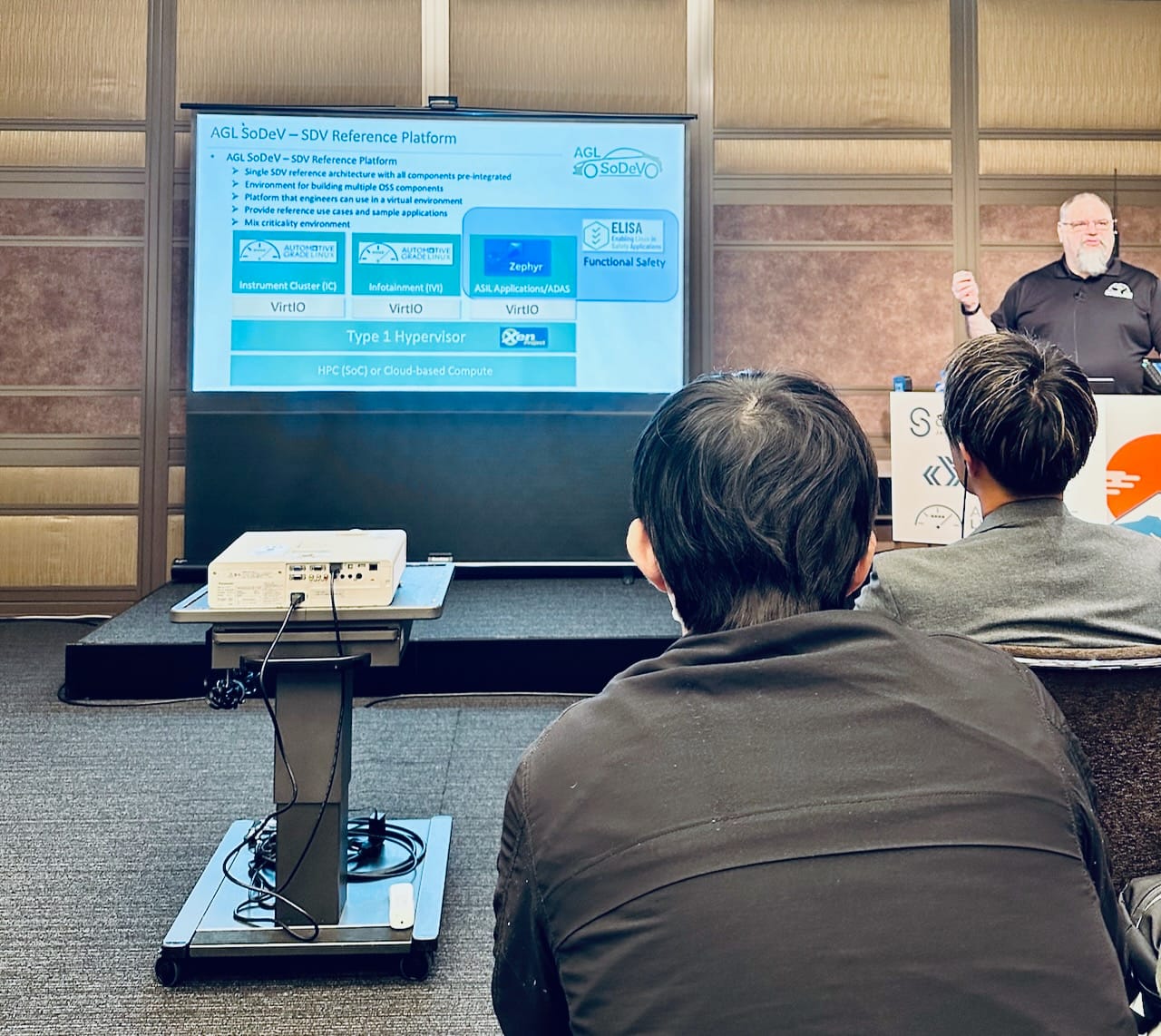
Across vendors and presentations, the same SDV stack kept appearing: AGL, Xen, Zephyr, VirtIO, and Yocto. This level of alignment is a strong sign that the industry is converging on shared, open foundations.
This level of alignment across vendors is a strong sign of maturity. When engineers agree on foundational building blocks, innovation accelerates. For SDVs, mixed criticality workloads are unavoidable. Infotainment, telematics, OTA services, sensor processing, and safety functions must coexist on the same SoC. This demands strong isolation and predictable performance, both of which Xen provides. Alongside Xen, Zephyr has clearly emerged as the go to real time operating system within this architecture, with a roadmap toward safety certification and growing adoption across automotive platforms.
Some OEMs, including Toyota, still rely heavily on QNX today. I had several thoughtful conversations with Toyota engineers who were curious about open alternatives. When organizations look for openness, strong performance, and a roadmap they can influence, Xen becomes increasingly attractive. While some benchmark data remains private, it is clear that modern open source hypervisors can match or exceed proprietary solutions in critical areas.
My Talk: Dom0less Xen for Deterministic Automotive Systems
An important part of this discussion is how Xen and Zephyr work together in practice.
I was glad to share how Xen can be configured in dom0less mode for embedded automotive use cases. The audience was highly engaged, particularly around deterministic startup behavior and the benefits of a smaller trusted computing base.
A recording of this session, along with other OSS Japan talks, will be added once they are published.
The presentation covered how Xen can run in dom0less mode, and how Zephyr fits naturally into this model as a lightweight, deterministic operating system:
- Predictable, parallel domain boot
- Bounded interrupt latency
- Clear isolation for safety critical systems
- A Raspberry Pi 5 proof of concept running Zephyr and Linux in multiple domains
- Early and natural alignment with the AGL SDV architecture
Xen provides strong isolation and determinism, while Zephyr delivers a lightweight, real-time OS with a clear path toward safety certification. Together, they form a practical foundation for mixed-criticality automotive systems.
These concepts illustrated how dom0less Xen supports reproducible, deterministic system behavior that maps well to automotive safety requirements. Zephyr makes an excellent fit for a very lightweight dom0 when needed, or for tightly scoped system domains that handle specific responsibilities during normal vehicle operation, such as diagnostics, monitoring, or controlled domain creation. After the session, several engineers reached out to discuss using dom0less Xen for cockpit systems, ECUs, robotics platforms, and industrial controllers. The level of interest was higher than I expected.
Xen 4.21: Modernization and Security for the Next Generation
These architectural advances are supported by strong upstream progress in Xen itself.
We also celebrated the release of Xen 4.21 in November 2025. This release represents a major step forward in modernization and security hardening.
Key improvements include:
- Arm security hardening and improved determinism
- More predictable interrupt latency
- Memory management refinements
- Broader CI coverage on Arm and x86
- Continued modernization of the codebase
- Early support for RISC V
These improvements strengthen Xen for real time and safety aligned workloads. As SDVs scale across architectures, having a hypervisor that works naturally on Arm, x86, and emerging RISC V platforms is a significant advantage. This flexibility is essential for OEMs building long lived platforms that must evolve over many years.

Safety Certification: a Community Driven Path Forward
Safety is the next major frontier for open hypervisors, and Xen is making steady progress.
- AMD achieved safety concept approval in 2024
- Renesas is actively working toward safety certification in 2025
- The Xen Project is building a community driven pilot for Safety Certification Ready
This work includes open safety artifacts, clear documentation, public CI, and reproducible system behavior. Zephyr follows a similar path, making the Xen and Zephyr combination particularly compelling for safety oriented SDV designs. As companies see a visible and transparent path toward certification, the case for using open source in safety critical environments becomes much stronger.
With AMD achieving safety concept approval and Renesas publicly working toward certification, the Xen community is building a transparent, collaborative path toward safety-ready open systems.
Why Automotive Companies Are Turning to Xen
This shift toward SDVs also enables another critical capability: over the air updates.
By the end of the week, the message was clear:
- Xen is already part of the AGL reference architecture
- Major vendors deploy Xen on real automotive hardware
- Performance is competitive with proprietary hypervisors
- Xen offers transparency, flexibility, and no licensing fees
- Companies can directly influence the roadmap through contributions
- The safety story continues to strengthen
This combination of openness, performance, and industry alignment is exactly what engineers and decision makers are looking for. SDV architectures built on Xen, Zephyr, and AGL make it possible to deliver frequent OTA updates that improve functionality, fix issues, and strengthen security over the lifetime of a vehicle. This is a dramatic change from the once per year, or less, update cycles that drivers are used to today.
Software-defined vehicles make frequent OTA updates possible. This unlocks new features, improves security, and extends vehicle lifetimes far beyond the traditional once-per-year update cycle.
Closing Thoughts and an Invitation
It would also be incomplete not to acknowledge the work of EPAM, another Xen Project member. While not physically present at the conference, EPAM’s engineering contributions were very much visible behind the scenes.
I left OSS Japan feeling proud of the Xen community and grateful for the leadership shown by Honda, Renesas, Panasonic, and many others shaping the future of automotive software. The demos were impressive, the hallway conversations were energizing, and the collaboration across projects felt stronger than ever. My own Raspberry Pi demo was built directly on EPAM’s ongoing work to create real world SDV architectures across multiple platforms, and it is a great example of how member contributions extend far beyond the show floor.
If your organization is exploring software defined vehicles, virtualization, or open automotive platforms, now is an excellent time to get involved. The Xen Project community is open, supportive, and excited to collaborate.
If your organization is exploring software-defined vehicles, virtualization, or open automotive platforms, the Xen Project community is open, collaborative, and ready to work together.
Feel free to reach out, and stay tuned as our safety work continues to move forward.